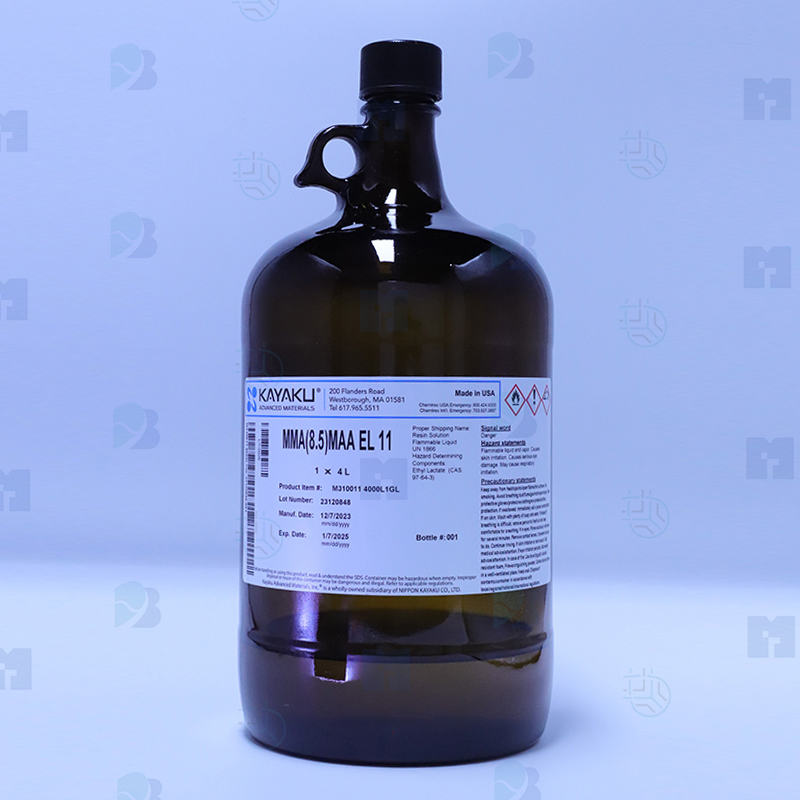
Model:
MMA
Main Components:
Ethyl lactate (75-100%)
CAS 97-64-3
Poly(2-methyl-2-propenoic acid-co-methyl 2-methyl-2-propenoate) (5-25%)
CAS 25086-15-1
Principle & Application Method:
Copolymer photoresist is a blend based on PMMA and ~8.5% methacrylic acid. Copolymer MMA (8.5) MAA is typically used in combination with PMMA for the bilayer lift-off photoresist process, where independent control of the CD dimension and profile of each photoresist layer is required. Standard copolymer photoresist is formulated with ethyl lactate and available in a wide range of film thicknesses. MMA (8.5) MAA copolymer electron beam positive photoresist features extremely high sensitivity (several times that of PMMA), enabling the fabrication of large-aspect-ratio structures after exposure and development. This is attributed to the significant difference in the dissolution rate of the photoresist during development, which yields the desired photoresist sidewall profile. Generally, the dissolution rate increases with the decrease in molecular weight, and this contrast can be further modulated by various process strategies.
Application Method:
1、Substrates shall be clean and dry. Solvent cleaning, O₂ plasma cleaning and O₃ cleaning are recommended.
2、Select the appropriate MMA dilution ratio and spin speed to achieve the target film thickness in accordance with the film thickness vs. spin speed curve.
3、Soft bake: 150°C for 60-90 s on a hot plate or 140°C for 30 min in an oven.
4、Exposure:
5、Development: Three process modes are available: immersion (21°C), spray and agitation. Development conditions shall be optimized based on process variables to achieve desired results.
6、Rinsing and drying: To terminate the development process and prevent crusting, immerse or spray the copolymer photoresist with MIBK:IPA (1:3 or 1:4), alcohol or deionized (DI) water immediately after development. Substrates are typically spin-dried at 3000 rpm for 20 s or blow-dried with N₂.
7、Hard bake (optional): Remove residual developer, rinse solution and moisture from the photoresist pattern. Hot plate: 100°C for 60-90 s; oven: 95°C for 30 min. Note: PMMA patterns will reflow at temperatures above 125°C.
8、Stripping: The copolymer photoresist can be stripped using MCC’s Remover PG or standard cleanroom solvents (e.g., acetone, photoresist thinner or positive photoresist stripper). Photoresists subjected to elevated processing temperatures and/or hard bake will require ACRYL STRIP or more aggressive stripping processes, including water bath heating with Remover PG to ensure complete photoresist removal.
Storage:
Ensure adequate ventilation and exhaust systems in the working area.
Prevent the formation of aerosols.
Store in sealed containers and keep in a cool, dry place.
Use explosion-proof equipment/devices and spark-proof tools.
Keep away from open flames and no smoking.
Prevent electrostatic discharge (ESD).