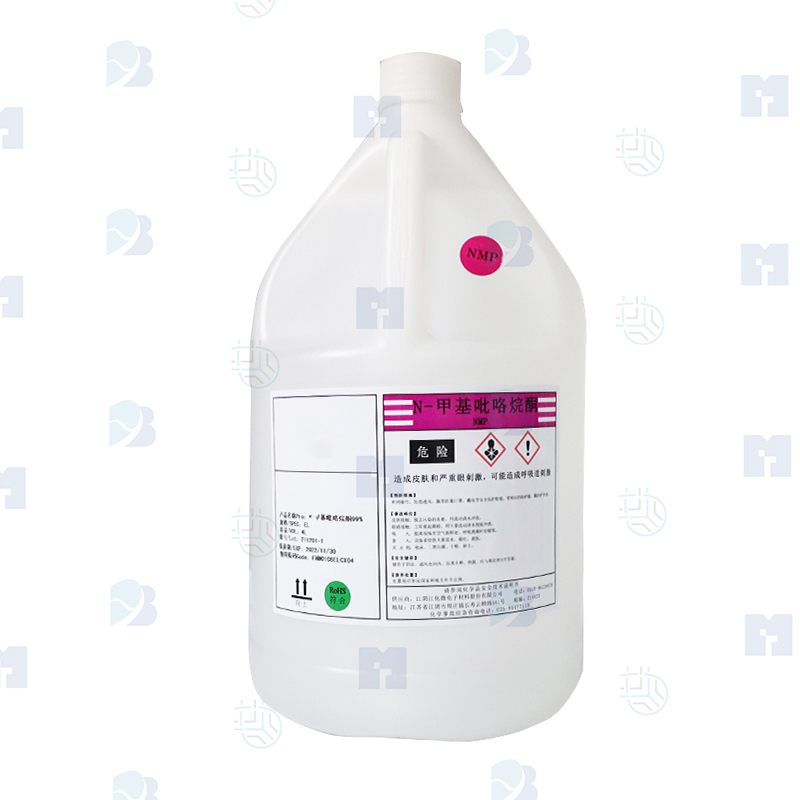
Model:
NMP
Main Components:
N-Methylpyrrolidone 99.5%
CAS 872-50-4
Mechanism & Application Principle:
NMP is a universal dipolar aprotic organic solvent. Owing to its high polarity, strong solubility, high boiling point and low freezing point, coupled with the high purity and superior quality of the NMP supplied by our company, it is widely used in the electronic information field. It serves as a cleaning agent for removing photoresist and other organic residues, a stripper for the lift-off process, a thinner for resists, a common solvent for electrolytes in lithium battery manufacturing, and an effective solvent for dissolving polyimide (PI) precursors, among other applications.
Operating Procedure:
Cascade cleaning is a common practice when NMP is used as a photoresist stripper. Prepare three cleaning tanks: the first tank is for the nearly complete removal of photoresist residues. Transfer the samples to the second tank to further clean residual photoresist, then to the third tank for final rinsing, followed by a thorough rinse with deionized water (DI water). When the pre-determined solvency limit is reached, discard the solution in the first tank and transfer the solutions in the second and third tanks one position forward respectively. Increasing the temperature (maximum 80℃) and applying ultrasonic/megasonic cleaning can enhance the photoresist stripping efficiency.
Storage:
Store in a cool and well-ventilated warehouse;
Keep away from ignition sources and heat sources;
Maintain the containers in a sealed condition;
Store separately from oxidizing agents;
Explosion-proof type facilities shall be adopted for lighting, ventilation and other equipment in the storage area, with switches installed outside the warehouse;
Do not use mechanical equipment and tools that are prone to generating sparks;
Inspect regularly for leakage;
During filling, control the flow rate (not exceeding 3 m/s) and ensure proper grounding devices are in place to prevent electrostatic accumulation;
Handle with care during loading and unloading to avoid damage to packages and containers.