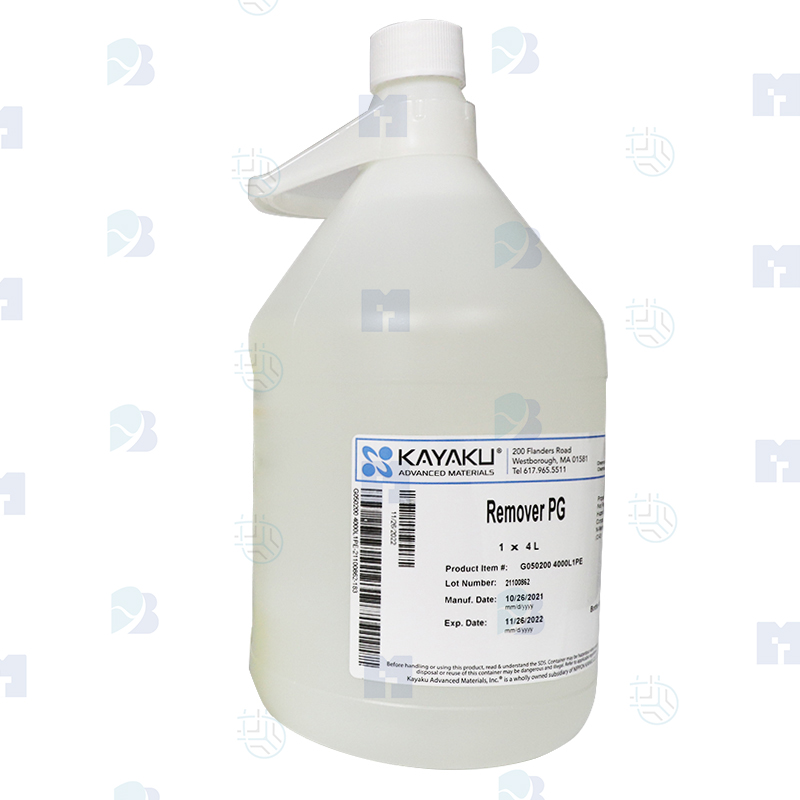
Model:
Remover PG
Main Components:
N-Methyl-2-pyrrolidone (NMP)
CAS 872-50-4
Mechanism & Application Principle:
As the content of dissolved photoresist increases, the photoresist stripping efficiency of Remover PG gradually diminishes with prolonged use. Even if the theoretical saturation limit (a solid content far above 50%) is not reached, the used solution will become opaque due to particle accumulation and is therefore no longer suitable for repeated cleaning. A common practice is cascade cleaning, which enables highly efficient and complete removal of PMGI, PMMA, SU-8 and other resist films from the surfaces of Si, silicon dioxide, gallium arsenide and many other substrates. Key requirements for the stripping process are: rapid photoresist removal without residues, and no damage to the substrate and the materials deposited thereon.
Operating Procedure:
1、Immerse the substrate in Remover PG at 50–80℃ to remove the majority of the photoresist.
2、Immerse the substrate from Step 1 in fresh Remover PG at 50–80℃ to eliminate residual material traces. Replace the stripping solution in a timely manner during the process to improve the stripping rate.
3、Immerse the aforementioned substrate in isopropyl alcohol (IPA) for rinsing to dissolve minor residual stripping solution.
4、Rinse the substrate with deionized water (DI water), followed by nitrogen blow-drying.
Note: In case of difficult stripping (e.g., after dense plasma etching or sputtering), ultrasonic or megasonic cleaning can significantly facilitate photoresist removal. However, sensitive structures on the substrate must be protected from damage during this process.
Storage:
Keep away from flammable materials, spark-generating sources, open flames and hot surfaces; smoking is prohibited in the storage and usage area.
Ensure the workshop is equipped with adequate ventilation and exhaust systems.